

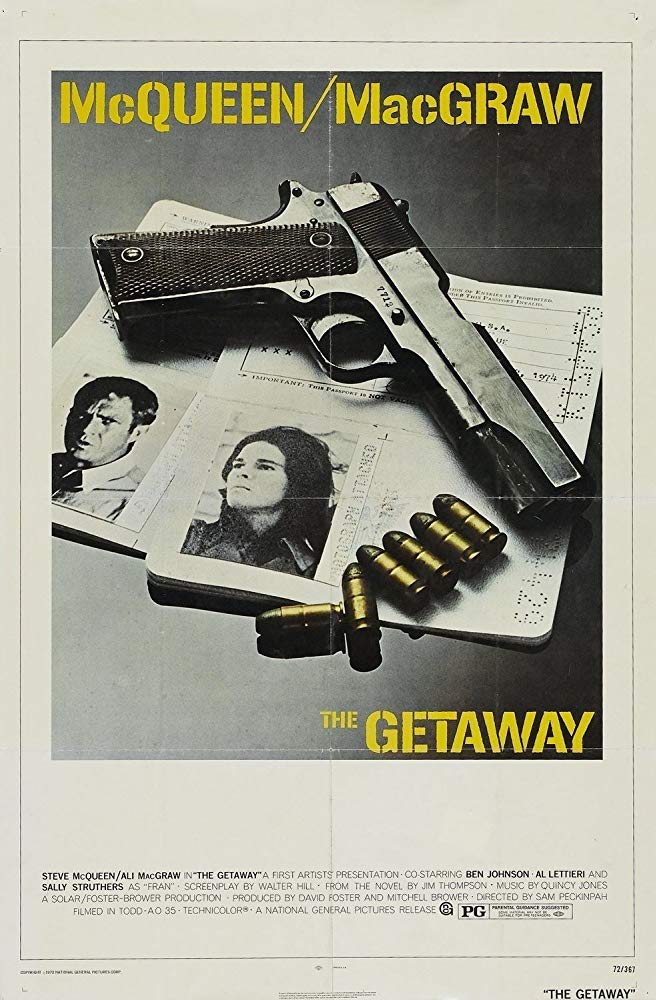
Sam Peckinpahs The Getaway funktioniert wie ein grosses aufgeblasenes Spielzeug für erwachsene Kinder (vor allem Männer). Wer erinnert sich nicht an die Art von Spielzeug, die man aufbaut, bestaunt - und dann? The Getaway ist ein ganz und gar unpersönlicher Film, der im Grunde nicht viel erreicht. Szene, Szene, Szene, aus. Man kann ihn leicht konsumieren und dabei die Verfolgungsjagten geniessen. Die Geschichte wirkt gekünstelt wie alles andere im Film: Steve McQueen spielt den Sträfling Carter „Doc“ McCoy. Damit McCoy auf Bewährung entlassen werden kann, macht seine Frau Carol (Ali MacGraw, die man nach den 70ern nie wieder sah) dem korrupten texanischen Politiker Benyon ein Angebot, das er nicht abschlagen kann: McCoy wird Benyon die Hälfte der Beute eines Bankraubs aushändigen. Dazu gibts einen Bonus: Carol selbst. Der Bankraub wird mehr oder weniger ungeplant durchgeführt. Der angebliche Profi McCoy hat sein Wissen darüber scheinbar aus alten Filmen und deshalb mietet er auch erst einmal ein Hotel-Zimmer, um hunderte von Fotos von der Bank zu machen (so wie in allen Bankraub Filmen eben). McCoy und Carol wohnen im Blickfeld aller gegenüber der Bank, fotografieren die ganze Zeit und McCoy sagt dann solche Sätze wie: "The guard is entering the bank at 8:59 a.m., one minute early". Ein paar alte Kabel zusammen gelötet und dann noch eine Skizze - das wars. Kurz vor dem Bruch gibts eine etwa fünfminütige Besprechung in einem Keller (wo kommt der eigentlich auf einmal her?) - anschliessend beginnt das Fiasko. Das Geld wird zwar erbeutet, aber ein Wachmann getötet und am Treffpunkt muss McCoy auf seinen eigenen Komplizen zielen, der ihn betrügen will. Carol erschiesst auch noch Benyon, nachdem der McCoy alles über ihren "Bonus" verraten hat. Es passiert noch eine ganze Menge, der verwundete Komplize taucht wieder auf, ein Trickbetrüger nimmt Carol die Beute ab (die McCoy wider beschafft) und schliesslich erscheint McCoys Bild in der Zeitung. Zusammengefasst: Die Beziehung des Ehepaares McCoy gerät mächtig unter Druck. Die Flucht der beiden läuft manchmal so merkwürdig ab, dass die Verfolger vor ihnen erscheinen und nicht hinter ihnen. Nie erklärt wird, warum eine ganze Reihe von Explosionen nach dem Überfall abgefeuert werden und nicht davor? Schliesslich platziert Carol eine Bombe im Heu eines Trucks - aber warum? Womöglich geschieht das alles nur, damit in El Paso ein grosser Showdown stattfinden kann? Jedenfalls treffen dort alle Protagonisten zur selben Zeit ein. Um keine Missverständnisse aufkommen zu lassen: Ab den frühen 60ern hat Sam Peckinpah fast im Alleingang den amerikanischen Western weiterentwickelt. Sein Drehbuchautor Walter Hill durfte ab den späten 70ern dieses Erbe antreten und auch er setzte ganz neue Impulse. Ich hatte mich auf The Getaway vor allem gefreut, weil ich hoffte, ein Liebespaar auf der Flucht zu sehen. Was für eine grosse Geschichte könnte dieser Plot alles hergeben? Was für eine grandiose Liebesgeschichte könnte das sein! Walter Hill aber interessiert sich nicht für die einzelnen Charaktere. In seinem Filmen gibt es nur Figuren, die handeln, aber nicht fühlen. Er ist ein Mann der 80er und diese Art, Filme zu machen klingt bereits 1972 mit The Getaway an. -
Sam Peckinpah's The Getaway works like a big inflated toy for adult children (especially men). Who doesn't remember the kind of toys you build, marvel at - and then? The Getaway is a completely impersonal movie, that basically doesn't achieve much. Scene, scene, scene, off. You can easily consume it and enjoy the chases. The story seems artificial like everything else in the movie: Steve McQueen plays the convict Carter "Doc" McCoy. So that McCoy can be released on probation, his wife Carol (Ali MacGraw, who you never saw again after the 70s) makes the corrupt Texas politician Benyon an offer he can't refuse: McCoy will hand Benyon half of the loot from a bank robbery. And there's a bonus: Carol himself. The bank robbery is more or less unplanned. The alleged professional McCoy has his knowledge about it apparently from old movies and therefore he rents a hotel room to take hundreds of photos of the bank (like in all bank robbery movies). McCoy and Carol live in everyone's field of vision opposite the bank, photographing all the time and McCoy then says such sentences as: "The guard is entering the bank at 8:59 a.m., one minute early". A few old cables soldered together and then a sketch - that's it. Shortly before the break there's a five-minute meeting in a cellar (where did it come from?) - then the fiasco begins. The money is captured, but a guard is killed and at the meeting point McCoy has to aim for his own accomplice, who wants to cheat him. Carol also shoots Benyon after McCoy has revealed everything about her "bonus". A lot more happens, the wounded accomplice reappears, a trickster takes Carol's loot from her (which McCoy regains) and finally McCoy's picture appears in the newspaper. Summarized: The McCoy couple's relationship comes under a lot of pressure. The escape of the two sometimes happens so strangely that the persecutors appear before them and not behind them. It is never explained why a whole series of explosions are fired after the robbery and not before? Finally Carol places a bomb in the hay of a truck - but why? Maybe it's all just so a big showdown can take place in El Paso? Anyway, all the protagonists arrive there at the same time. To avoid any misunderstandings: From the early 60s on Sam Peckinpah developed the American Western almost on his own. His scriptwriter Walter Hill was allowed to take up this legacy from the late 70's and he also set completely new impulses. I had been looking forward to The Getaway above all because I hoped to see a couple of lovers fleeing. What kind of big story could this plot tell? What a grandiose love story it could be! But Walter Hill is not interested in the individual characters. In his films there are only characters who act, but don't feel. He is a man of the 80's and this way of making movies is already reminiscent of 1972 with The Getaway.
Kommentare
Eure letzten Kommentare
Vincent Canby (New York Times
Vincent Canby (New York Times): Sam Peckinpah's new film, "The Getaway," the story of an Ivy League-looking ex-con (Steve McQueen), his remarkably chic wife (Ali McGraw) and some double- and triple-crossing associates who, early on, hold up a bank in San Antonio and then spend the rest of the film trying to get away from the cops and from one another. More or less.
That qualification is necessary because if you take the characters at face value—which is what one usually does in this kind of film—then certain key decisions they make reflect on their sanity, which is otherwise unquestioned. From where any critic sits, it's impossible to tell whether this confusion is the result of the writing, the direction or the editing.
In concentrated bursts, "The Getaway" occasionally comes to vivid, melodramatic life, as in a sequence in which McQueen hunts down a small-time thief who has stolen his valise containing $500,000, probably under the notion that it contains some hockable jewelry or traveler's checks.
A subplot (actually more interesting than the main plot) details the easy decline and fall into whoredom of a veterinarian's dim-witted wife (enthusiastically played by Sally Struthers of "All in the Family"), when she and her husband are kidnapped by one of the bank robbers.
The film depends mostly on simpler, stickier sorts of sensation, such as the curious spectacle of Steve and Ali surviving inside the stuffed bowels of a garbage truck. Upon emerging, or being dumped, Ali does have one small scratch on her forehead and some smudges on her frock, but I doubt whether she'd be turned away from the door of "21."... The action and the violence of "The Getaway" are supported by no particular themes whatsoever. The movie just unravels. (Quelle: http://www.nytimes.com/movie/review?res=9401E2DB1E3DEF34BC4851DFB467838…)
- Anmelden oder Registieren, um Kommentare verfassen zu können

Peckinpah injecting some of
Peckinpah injecting some of his trademark style (and trademark violence) into a routine genre assignment. The results aren't as powerful or as memorable as many of the director's more personal projects, but nonetheless there are some amazing sequences, moments & supporting characters littered throughout, with the natural screen presence/chemistry between McQueen & McGraw giving the action a much needed human element.
- Anmelden oder Registieren, um Kommentare verfassen zu können
Werde Teil der Community
Schreibe Kommentare, vote für Deine Favoriten oder sende uns Deinen Film-Vorschlag.