

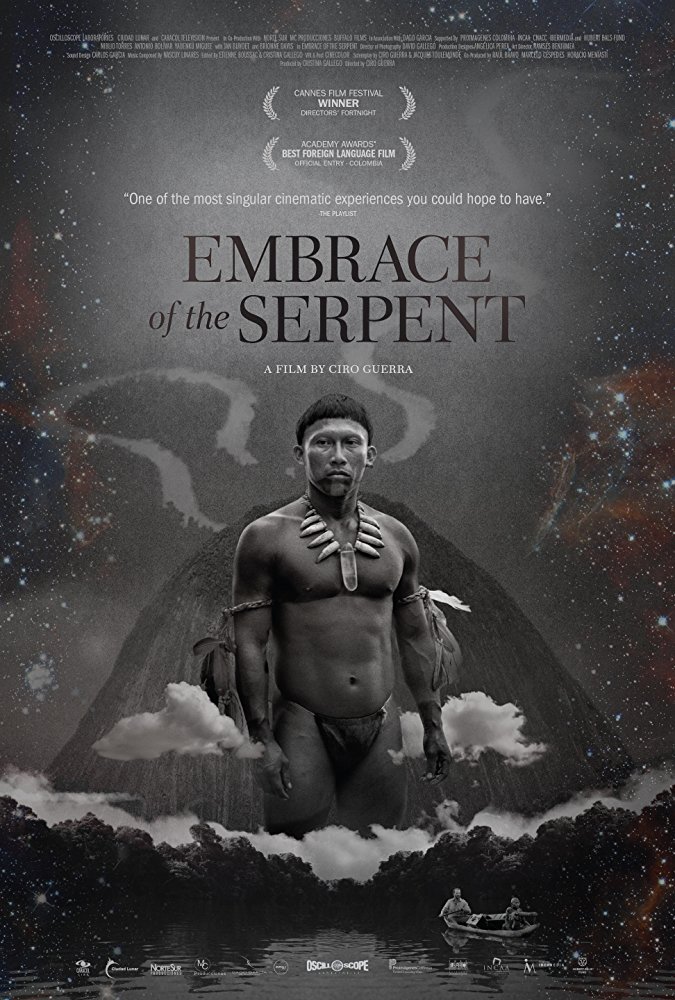
El abrazo de la serpiente ist in Drama über die Auswirkungen der europäischen Kolonialisierung im Amazonas. Der Film basiert frei auf den Reisetagebüchern des deutschen Anthropologen Theodor Koch-Grünenberg, der um 1900 das Amazonas Gebiet erforschte. Im Film begibt er sich mit einem ehemaligen Sklaven und einem jungen Schamanen namens Karamakate auf eine Flussfahrt im Grenzgebiet von Kolumbien und Brasilien. "Theo" will nicht nur die Eingeborenen studieren, sondern mittels einer legendären Pflanze seine eigene Erkrankung heilen. Die zweite Handlungsebene spielt 40 Jahre später. Sie lehnt sich an der Expedition des amerikanischen Ethnobotanikers Richard Evans Schultes an. Beide Zeitebenen werden durch gemeinsame Motive und identische Situationen miteinander verbunden. Die Wege beider Forscher verschmilzen zu einer meditativen Reise. Evans sucht dieselbe mystische Pflanze wie Theo. Auch er wird von Karamakate begleitet, dem letzten Vertreter seines Stammes, der nicht ausgerottet wurde. Karamakate führt ein einsames Leben. Er wird zum weisen Führer in eine unbekannte Welt, aber auch zum Zuschauer. Vielleicht ist das seine Bestimmung? In El abrazo de la serpiente sehen wir den Dschungel durch die Perspektive Karamakates, wodurch er nicht wie das Herz der Finsternis wirkt. Weder wird die Wildnis poetisiert, noch mystifiziert. Schrecken und Bedrohung gehen nur von den Eindringlingen aus. Leider vertraut Regisseur Ciro Guerra seinen Bildern und Figuren zu wenig. Warum muss Karamakate sein eigenes Schicksal mit so vielen Worten kommentieren? Weshalb diskutiert er seine Einsamkeit und verlorene Kultur dann noch einmal in derselben Länge mit Evans? Mich hat das ein wenig frustriert, gerade weil der Film in jeder anderen Hinsicht so einzigartig ist: Er zeichnet seine Charaktere voller Klarheit und Humor und setzt ein einmaliges Konzept so aussergewöhnlich um, dass wir es hier mit einem modernen Klassiker zu tun haben! - El abrazo de la serpiente is in Drama about the effects of European colonization in the Amazon. The film is freely based on the travel diaries of the German anthropologist Theodor Koch-Grünenberg, who explored the Amazon region around 1900. In the film he takes a former slave and a young shaman named Karamakate on a river cruise in the border area of Colombia and Brazil. "Theo" not only wants to study the natives, but also wants to cure his own illness with a legendary plant. The second level of action takes place 40 years later. It is based on the expedition of the American ethnobotanist Richard Evans Schultes. Both time levels are connected by common motifs and identical situations. The paths of both researchers merge into a meditative journey. Evans is looking for the same mystical plant as Theo. He too is accompanied by Karamakate, the last representative of his tribe who has not been exterminated. Karamakate leads a lonely life. He becomes a wise guide to an unknown world, but also a spectator. Maybe that's his destiny? In El abrazo de la serpiente we see the jungle through Karamakate's perspective, so it does not look like the heart of darkness. The wilderness is neither poetized nor mystified. Horror and threat come only from the invaders. Unfortunately, director Ciro Guerra doesn't trust his pictures and characters enough. Why must Karamakate comment on his own fate with so many words? Why is he discussing his loneliness and lost culture again in the same length with Evans? I was a little frustrated because the movie is so unique in every other respect: He draws his characters full of clarity and humor and implements a unique concept so extraordinarily that we are dealing with a modern classic!
Translated with www.DeepL.com/Translator
Kommentare
Eure letzten Kommentare
Reminiscent of apocalypse now
Reminiscent of apocalypse now and Aguirre the Wrath of God in a foreigner's unknown descent down a river where they don't belong. The horror and cultural alienation are well trodden, but Serpent still brings forth new ideas. If the Western man's role is not to "civilize" are they supposed to leave the rest of the world in isolation? Is peaceful interaction and real cultural embrace possible without destruction?
- Anmelden oder Registieren, um Kommentare verfassen zu können
Werde Teil der Community
Schreibe Kommentare, vote für Deine Favoriten oder sende uns Deinen Film-Vorschlag.