Do, 27/03/2014 - 16:52
Directed by:
Leos Carax
Schauspieler:
Juliette Binoche
Denis Lavant
Klaus Michael Grüber
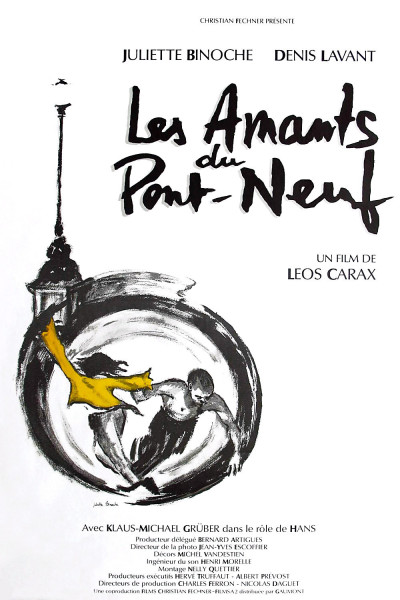
The Lovers on the Bridge bleibt als eine der berüchtigtsten Produktionen der französischen Filmgeschichte in Erinnerung. Eine so kostenspielige Liebhaberei, dass nicht wenige damals fassungslos reagierten. Der Regisseur Leos Carax nannte niemanden Geringeres als den grossen Jean-Vigo als Inspiration und erschuf ein Melodram, dass aus der klassischen Zeit Hollywoods kommen könnte. Ein Film, einerseits glorreich und andererseits fast lächerlich. Alles beginnt auf der Pont Neuf, der ältesten Brücke von Paris. Hier begegnen sich zwei Landstreicher. Die Künstlerin Michele (Juliette Binoche), die langsam erblindet und der Feuerschlucker Alex (Denis Lavant). Wer sich fragt, wie zwei Obdachlose ausgerechnet die Pont Neuf als Wohnsitz wählen, der muss wissen, dass die Brücke im Film wegen Bauarbeiten gesperrt wurde. Inmitten von Zement-Säcken und Pflastersteinen könnte also schon so etwas wie ein Zuhause entstehen. Ihr Vermieter ist der mürrische Clochard Hans (Klaus-Michael Gruber). Hört sich an wie ein netter kleiner Arthaus Film? In den Händen von Leos Carax aber wuchsen die Produktions-Kosten ins Unermessliche. Wer auf wikipedia nachlesen will, weshalb, erfährt, dass unter anderem die Drehgenehmigung auf der Pont Neuf irgendwann auslief, so dass Carax sie kurzerhand rekonstruieren liess. Doch nicht nur die Brücke - auch noch das Samaritaine! Sein Liebespaar würde sowohl als rücksichtslos als auch geheimnisvoll charakterisieren. Lange verrät Michele nicht, dass sie erblindet. Alex liebt sie zwar, würde aber wohl auch in ihre ehemalige Wohnung einbrechen. Und Hans versucht sie immer wieder von der Brücke zu vertreiben, da ein solcher Ort nichts für Michele ist. In Erinnerung bleiben aber vor allem die Bilder: Wenn Alex ein Rad auf der Brücke schlägt und beide ein Polizei-Boot kapern, um vor dem Feuerwerk der Zweihundertjahr-Feier Wasser-Ski zu fahren. Alex verdient Geld durch sein Feuerschlucken und Michele mixt Drogen in die Drinks von Touristen, um sie zu bestehlen. Schöne Szenen für sich genommen, die Carax aber immer wieder durch Anflüge harter Realität bricht. Einmal fackelt Alex einen Mann ab, der Vermissten-Poster von Michele aufhängt. Dennoch gelingt es, den Bogen zu einem melodramatischen Finale zu spannen, der uns fast zum Lachen herausfordert. Juliette Binoche agiert fast wie ein Stummfilm-Star. Ihre Michele ist ein charmanter Charakter, während Alex eher abstossend wirkt. Wie auch sonst? Als seine grösste Liebesbekundung darf das Verbrennen eines Menschen gelten, damit Michele bei ihm bleibt. In ihrer Gegenwart aber ist Alex entweder mürrisch oder betrunken. Zwei junge Menschen, die sich dafür entscheiden, unglücklich zu sein. The Lovers on the Bridge liebt grosse Gesten und berührende Momente der Wahrheit - doch all das auf einem Fundament aus Balsa-Holz. Um sein unerschütterlich albernes Weltbild auf die Leinwand zu bringen, wartete Carax ganze sieben Jahre. Wie im Märchen. - The Lovers on the Bridge is remembered as one of the most notorious productions in French film history. A fondness so costly that not a few were stunned at the time. Director Leos Carax cited none other than the great Jean-Vigo as inspiration and created a melodrama that could have come out of the classic Hollywood era. A film glorious on the one hand and almost ridiculous on the other. It all begins on the Pont Neuf, the oldest bridge in Paris. Here two tramps meet. The artist Michele (Juliette Binoche), who is slowly going blind, and the fire-eater Alex (Denis Lavant). If you're wondering how two homeless people choose the Pont Neuf of all places to live, you should know that the bridge in the film was closed for construction. So in the midst of cement sacks and cobblestones, something like a home could already be created. Their landlord is the grumpy clochard Hans (Klaus-Michael Gruber). Sounds like a nice little arthouse film? In the hands of Leos Carax, however, the production costs grew immeasurably. If you want to find out why on wikipedia, you'll learn that, among other things, the filming permit on the Pont Neuf expired at some point, so Carax had it reconstructed without further ado. But not only the bridge - also the Samaritaine! His lovers would characterize as both ruthless and mysterious. For a long time Michele does not reveal that she is going blind. Alex loves her, but would probably break into her former apartment. And Hans keeps trying to drive her away from the bridge, since such a place is not for Michele. What remains in the memory, however, are the images: When Alex does a cartwheel on the bridge and they both hijack a police boat to go water skiing before the fireworks of the bicentennial celebration. Alex making money from his fire-eating and Michele mixing drugs into tourists' drinks to steal from them. Beautiful scenes in their own right, but Carax repeatedly breaks them with touches of harsh reality. At one point, Alex torches a man hanging missing persons posters of Michele. Still, it manages to build to a melodramatic finale that almost dares us to laugh. Juliette Binoche acts almost like a silent film star. Her Michele is a charming character, while Alex is rather off-putting. How else? His greatest expression of love may be the burning of a human being so that Michele will stay with him. In her presence, however, Alex is either sullen or drunk. Two young people who choose to be unhappy. The Lovers on the Bridge loves grand gestures and touching moments of truth - but all of it built on a foundation of balsa wood. To bring his unshakably silly worldview to the screen, Carax waited a full seven years. Like a fairy tale.



Werde Teil der Community
Schreibe Kommentare, vote für Deine Favoriten oder sende uns Deinen Film-Vorschlag.