

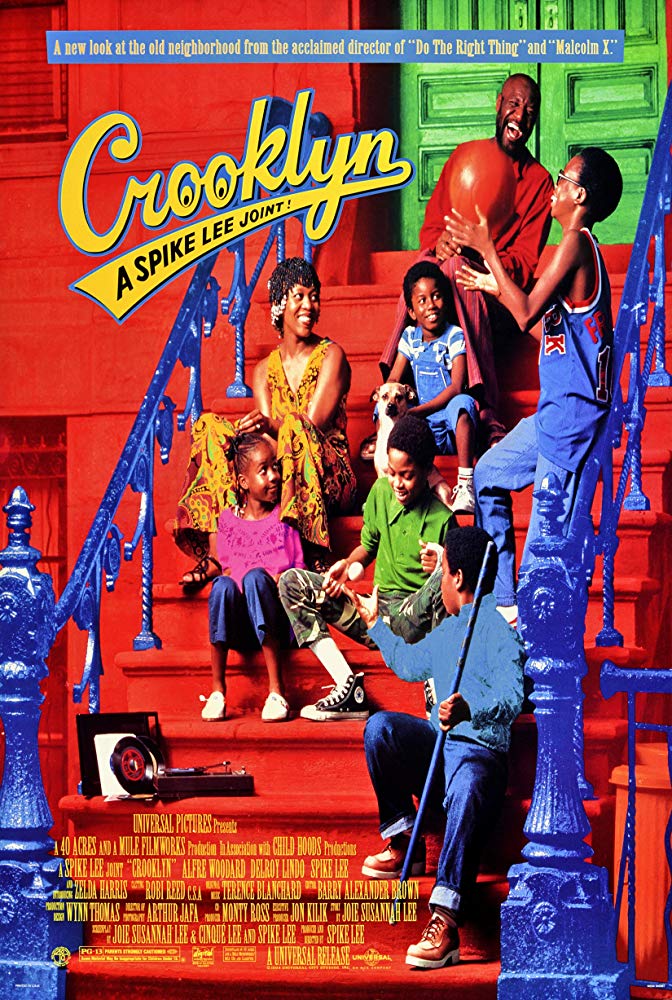
Versetzen wir uns zurück in das Jahr 1994, denn in diesem Jahr entstand Crooklyn. Crooklyn erinnert sich an die 70er und wie es war, in Brooklyn aufzuwachsen. Aus der Perspektive von 1994 muss es wie ein goldenes Zeitalter gewirkt haben ohne Bandenkriege und Crack. Ich würde mich interessieren, wie Spike Lee heute die frühen 90er sieht? Die Carmichaels sind eine Familie mit vier Jungs und einem Mädchen. Sie leben in einem Haus aus diesen typischen rötlichen Backsteinen und verbringen die meiste Zeit auf der Strasse. Jeder kennt dort jeden, jeder hat so seine Probleme und doch, Crooklyn pulsiert voller Liebe und Leben! Wir werden während der ersten Szene unmittelbar hineingeworfen in das Familienleben. im Fokus steht die jüngste Tochter Troy (Zelda Harris). Der Vater Woody (Delroy Lindo) verdiente früher gutes Geld mit Pop, versucht sich nun aber in ernsthafteren Kompositionen - ohne Einkommen. Die Mutter Carolyn (Alfre Woodard) ist Lehrerin, die Jungs nette ausgelassene Chaoten. Spike Lee hat das Drehbuch gemeinsam mit seinem Bruder und seiner Schwester geschrieben, wobei es wohl nur "inspiriert" sei und nicht autobiographisch. Viele Episoden aus Crooklyn wirken aber wie gerade aus dem Leben gegriffen, so der Showdown zwischen Mutter und Sohn, eine Platte Black-Eyed-Peas abzuwaschen. Schön auch die Familienstreits, wenn Carolyn ihren Mann aus dem Haus wirft, weil er nichts zum Familien Einkommen beiträgt. Spike Lee ist einer der Regisseure, die experimentelle Ansätze wagen. Besonders pointiert wird das während der Szenen in Virginia vorgeführt, da Lee die Vorstadt-Welt ausleuchtet, als ob es ein anderer Planet sei. In Crooklyn dagegen ist Ärger ein permanenter Begleiter der Carmichaels, jedoch keiner, der sich nicht lösen liesse. Manche der Erinnerungen in Crooklyn aber offenbahren die Qualen des echten Lebens (so dass ich denke, Lee inszeniert in diesen Passagen doch autobiographisch): Ich erinnere mich an die Szene, da Carolyn ihren Kindern aufträgt, die Küche aufzuräumen, bevor sie zu Bett gehen. Sie tun es nicht, Carolyn rastet nachts aus und schleppt sie in die Küche. Carolyn scheint nahe an einem Zusammenbruch, die Kinder wirken haltlos und eingeschüchtert. Verletzungen, die im Gedächtnis bleiben und später erfahren wir einige der Beweggründe Carolyns. Spike Lee hat Crooklyn nicht im Sinne einer "geordneten" Inszenierung gedreht, sondern durcheinander - wie das Leben. Er bietet auch keine "Coming Of Age" Elemente, keine Auflösungen an. Am Ende sind die Kinder eben immer noch Kinder. Während des Abspanns sehen wir wundervolle Aufnahmen davon, wie die Jungs in den Strassen Brooklyns spielen. Lee betont, dass diese Spiele heute ausgestorben seien und er sie den Schauspielern erst wieder beibringen musste. -
Let's go back to the year 1994, when Crooklyn was born. Crooklyn remembers the 70s and how it was to grow up in Brooklyn. From the perspective of 1994 it must have looked like a golden age without gang wars and crack. I would be interested to know how Spike Lee sees the early 90s today? The Carmichaels are a family of four boys and a girl. They live in a house made of these typical reddish bricks and spend most of their time on the street. Everybody knows everybody there, everybody has his problems and yet, Crooklyn pulsates with love and life! During the first scene we are immediately thrown into family life. The focus is on the youngest daughter Troy (Zelda Harris). The father Woody (Delroy Lindo) used to earn good money with pop, but now tries his hand at more serious compositions - without any income. The mother Carolyn (Alfre Woodard) is a teacher, the boys are nice and cheerful chaotic people. Spike Lee has written the script together with his brother and sister, whereby it is probably only "inspired" and not autobiographical. However, many episodes from Crooklyn seem to have just been taken out of life, like the showdown between mother and son to wash off a record of Black-Eyed-Peas. It's also nice to see the family arguments when Carolyn kicks her husband out of the house because he doesn't contribute anything to the family income. Spike Lee is one of the directors who dare experimental approaches. This is especially pointed during the scenes in Virginia, as Lee illuminates the suburban world as if it were another planet. In Crooklyn, on the other hand, anger is a permanent companion of the Carmichaels, but not one that can't be solved. But some of the memories in Crooklyn reveal the torments of real life (so I think Lee is autobiographical in these passages): I remember the scene when Carolyn tells her kids to clean up the kitchen before they go to bed. They don't, Carolyn freaks out at night and drags her into the kitchen. Carolyn seems close to a breakdown, the children seem unstable and intimidated. Injuries that remain in memory and later we learn some of Carolyn's motives. Spike Lee didn't shoot Crooklyn in the sense of an "ordered" staging, but in a confused way - like life itself. He also doesn't offer "Coming Of Age" elements, no resolutions. In the end the children are still children. During the credits we see wonderful shots of the boys playing in the streets of Brooklyn. Lee emphasizes that these games are extinct today and that he had to teach them to the actors again.
Translated with www.DeepL.com/Translator
Kommentare
Eure letzten Kommentare
A classic childhood mixtape
A classic childhood mixtape that's stuck with me since I was younger than most of the kids in the film. It falters here and there (the anamorphic lens stuff is more distracting than anything else), but the camerawork is fantastic, the bickering is perfectly-orchestrated, and it features what's easily the greatest pop soundtrack ever assembled for a film.
- Anmelden oder Registieren, um Kommentare verfassen zu können
Werde Teil der Community
Schreibe Kommentare, vote für Deine Favoriten oder sende uns Deinen Film-Vorschlag.